Philip the Evangelist: Highlights of a Life of Devotion
By Anthony Barbera
April 24, 2026
Whenever I begin a new project—whether sharing an idea or writing a book—I ask myself one question:
Why is this important to the reader or listener, and how will it be of help to their life?
Philip is one of the most fascinating—and often overlooked—figures in the early church. We all recognize names like Peter, John, James, and even Stephen. But Philip the Evangelist is someone worth knowing well.
Philip first appears in Acts chapter six, as one of seven men chosen to serve the growing church, particularly to care for the widows. He is not an apostle, yet his calling quickly becomes something powerful—he becomes an evangelist, a man sent to carry the message of Christ to the world.
By Acts 8, Philip steps into the center of the story.
Taking the Gospel Beyond Jerusalem
After persecution breaks out following Stephen’s death, believers are scattered. Philip does not retreat—he moves forward.
He travels to Samaria, a place many Jews avoided due to deep historical hostility. This is not a casual decision; it is a bold step across cultural and religious divisions.
He preaches Christ openly. The response is immediate and powerful. Crowds gather. People believe. The sick are healed. Many are baptized. Lives are changed, and long-standing barriers begin to fall.
In Samaria, so many are baptized through Philip’s preaching that Peter and John are sent from Jerusalem to confirm the work and demonstrate the receiving of the Holy Spirit, just as it had been revealed at Pentecost. As Jesus said, “These signs will accompany those who believe… they will speak in new tongues.”
In doing this, Philip follows the path first opened by Jesus, bringing the message of salvation to a divided people and watching that division begin to heal.
A Man Sent Alone
There is something unusual about Philip’s ministry—he often goes alone.
While others are sent in pairs, Philip moves at God’s direction with quiet boldness. His effectiveness is not tied to position or title, but to obedience. He listens, and he goes.
The Ethiopian Official
One of the most remarkable moments in Scripture unfolds on a desert road.
Philip is directed by an angel toward the road leading down to Gaza. There he encounters a high-ranking official from the kingdom of Kush—referred to as “Ethiopia” in the text—a man of great authority serving under the queen, the Kandake.
This is no ordinary traveler. A man of his status would have had a driver, guards, and attendants.
And in the carriage, the man is reading.
The Scroll and the Question
He is reading from the prophet Isaiah—out loud.
In the ancient world, reading aloud was common, especially when working through difficult texts. This is not casual reading. He is searching for understanding.
Philip hears him and asks a simple question:
“Do you understand what you are reading?”
The man’s answer is striking in its honesty:
“How can I, unless someone guides me?”
He invites Philip to join him.
What he is reading is Isaiah 53—the passage describing the suffering servant. The wording aligns with the Septuagint, indicating he is reading in Greek—the common language of the broader world.
Before Philip ever arrived, the Word of God was already in this man’s hands—in a language he could understand.
From Isaiah to Christ
Philip begins exactly where the man is.
He does not shift topics. He does not complicate the moment. Starting with the Scripture before them, he explains the good news about Jesus.
In that moment, the words of Isaiah come into focus. What was once unclear becomes personal and immediate. The Old Testament is no longer distant—it is fulfilled.
Water in the Wilderness
As they travel, talking about Jesus and the good news, they come upon water.
In a desert region, this is unexpected. Yet the man responds immediately:
“Look, here is water. What prevents me from being baptized?”
There is no delay. He has heard, understood, and believed.
On that roadside, far from Jerusalem, he is baptized.
In this record, there is no mention of anyone else traveling with the queen’s treasurer. However, that is highly unlikely. He certainly would have had guards and a driver. Scripture often narrows the lens this way—not because others are absent, but because this is the life God is calling in that moment.
Two Journeys Continue
After the baptism, everything changes in an instant.
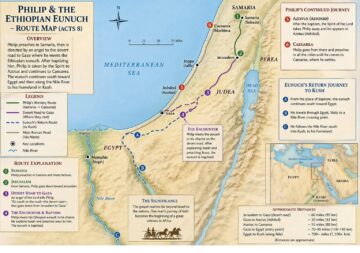
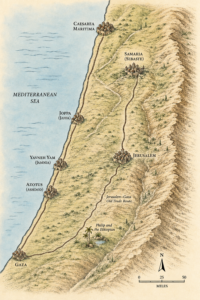
Philip the Evangelist is suddenly taken away by the Spirit and later appears further north at Ashdod—one of the oldest and most significant cities of the Philistines. From there, he continues his work, preaching as he moves from town to town up the coast.
It is a moment many readers pass over too quickly. One moment Philip is on a desert road… the next, he is placed somewhere entirely new, continuing the mission without pause.
Meanwhile, the Ethiopian official continues his journey south.
His likely route would take him into Egypt, then along the Nile River, and finally back into the kingdom of Kush—deep into Africa.
But he does not return the same.
What he carries with him is more than the memory of an encounter.
He carries understanding.
He carries the message of Christ.
The Road to Caesarea
From Ashdod, Philip continues north along the coastal route, preaching in every town until he reaches Caesarea.
Along the way, he likely passes through cities such as Ashkelon, Ashdod, Yavne-Yam, and Joppa.
Kush and “Ethiopia”
The Bible refers to him as an Ethiopian. Still, in the ancient world, this term broadly refers to lands south of Egypt—most likely the kingdom of Kush, centered in what is now Sudan.
These regions were connected through trade and travel, making this encounter even more significant. The Word of God is now being carried to the doorway of Africa.
Through one man, the message of Christ is already moving into new lands.
Conclusion: A Life That Moves When God Speaks
Philip’s story is not about position. It is about obedience.
He goes where others would not go. He speaks when prompted. He meets one man on a quiet road and, through that encounter, the message of Christ begins to move outward.
From Jerusalem to Samaria, from a desert road to Caesarea, his life traces the early movement of the gospel—crossing boundaries and reaching hearts one at a time.
God does not always move through crowds.
Sometimes, He moves through one willing servant…
and one ready heart.
“But you shall receive power when the Holy Spirit has come upon you; and you shall be witnesses to Me in Jerusalem, and in all Judea and Samaria, and to the end of the earth.”
Acts 1:8
Continue the Journey
If Philip’s story stirred your interest in the world of the early church and the lives shaped by God’s calling, you may also enjoy these biblical novels rooted in Scripture.
Jonah: In the Time of the Kings explores a prophet running from God—and the mercy that pursues him.
Elijah: Fire from Heaven continues the story, bringing readers into a nation on the brink of judgment and a prophet who will not bow.
These stories are written to inspire, encourage, and bring Scripture to life.
Gratitude,
Anthony Barbera
April 24, 2026
f you enjoy exploring the Bible, experience these events as a powerful story—rooted in Scripture and written to inspire faith, courage, and conviction.
Read the first chapters of Elijah: Fire from Heaven

3 Comments
I love how you shared the balance of holding forth the truth of God between many folks or one solitude believer listening to God and how this light continues to move through the nations. Where did the Ethiopian get the scriptures? I look forward to your book and historical writing tying all this together in a novel!!
Love the personal fellowship we can have with our heavenly Father and open doors to speak the word.
Thanks Mark. Hope you’re having a great weekend.
Comments are closed.