When Jesus told his disciples that they would be his witnesses “in Jerusalem, and in all Judaea, and in Samaria, and unto the uttermost part of the earth” (Acts 1:8), Samaria was not simply another place on a map.
It represented a boundary.
For generations, Jews and Samaritans had lived near one another while remaining deeply divided. They shared ancient roots and belief in the God of Israel, yet centuries of religious, political, and cultural hostility separated them. The Gospel of John states the problem plainly:
“The Jews have no dealings with the Samaritans.” — John 4:9
And yet Jesus went there.
Early in his ministry, Jesus traveled through Samaria and stopped at Jacob’s well near Sychar. There he spoke with a Samaritan woman—something remarkable in itself—but the encounter did not end with her.
Jesus revealed things about her life that he could not have known by ordinary means. Astonished, she returned to her town and told the people:
“Come, see a man, which told me all things that ever I did: is not this the Christ?” — John 4:29
The people came, and Jesus remained with them for two days. By the time he left, many Samaritans believed—not merely because of the woman’s testimony, but because they had now heard Jesus for themselves.
That makes what happened later in the Book of Acts especially impactful.
Jesus Had Already Prepared the Ground
After his resurrection, Jesus gave his followers the pattern of what was coming: Jerusalem. Judea. Samaria. Then the uttermost parts of the earth.
Yet the young church remained largely centered in Jerusalem until persecution erupted following the death of Stephen. That tragedy changed everything.
Believers fled the city, carrying the gospel with them. And Acts tells us:
“Then Philip went down to the city of Samaria, and preached Christ unto them.” — Acts 8:5
Philip did not arrive in completely untouched territory. And he went by himself.
Jesus had been there before him.
Some who heard Philip may have remembered the Galilean teacher who had once stayed among them. Perhaps stories of the woman at Jacob’s well were still being told. Scripture does not tell us who remembered those two extraordinary days, but one thing is certain:
The seed had already been planted.
Now Philip came to water it.
Philip Crossed a Boundary
One of the things I find most remarkable about Philip is that he appears to have gone to Samaria on his own. (Of course, Peter and John joined him later.)
Philip did not arrive surrounded by apostles or accompanied by an impressive delegation from Jerusalem. Acts simply tells us that Philip went.
And people listened.
Crowds gathered. Unclean spirits came out. The paralyzed and lame were healed. Acts 8:8 summarizes the result in one wonderfully simple sentence:
“And there was great joy in that city.” — Acts 8:8
Think about that.
A city separated from the Jews by generations of religious bitterness suddenly experienced great joy because one Greek-speaking Jewish follower of Jesus came preaching the Messiah.
Philip crossed the boundary.
One Man Captured the Attention of a City
Philip had no army behind him. No political authority. No wealth or earthly position.
Yet Acts tells us that the people listened closely to what he said because they heard him and saw the miracles he performed. One man had entered Samaria proclaiming Christ, and an entire city began to pay attention.
That is remarkable.
Perhaps Philip himself did not fully understand how much preparation had already taken place before he arrived. Jesus had preached there. The Samaritan woman had testified there. Others had believed and carried the story forward.
Philip simply obeyed and went.
Sometimes that may be how God works with us as well.
We arrive thinking we are beginning something when, in reality, God has been preparing the ground long before we ever appeared.
Philip Continued What Jesus Began
There is a beautiful continuity between John 4 and Acts 8.
At Jacob’s well, Jesus told the Samaritan woman that the time was coming when true worshipers would worship the Father in spirit and in truth.
Years later, Philip arrived proclaiming the risen Christ.
Peter and John would join him later, but Philip was the one who first stepped across that boundary and began preaching.
And when Philip continued his journey, Scripture again presents him as traveling alone.
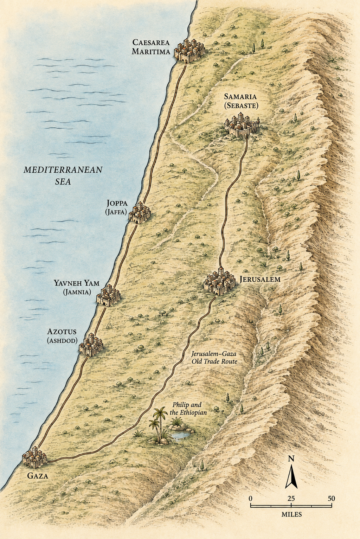
God sent him south toward the road to Gaza, where he encountered the Ethiopian official. After that extraordinary meeting, Philip was found at Azotus and continued preaching through the coastal towns until he eventually reached Caesarea.
Again and again, Philip went where he was directed.
Samaria. The Gaza road. The coastal cities. Caesarea.
The pattern Jesus had given was unfolding before his eyes.
Sometimes the Most Important Thing Is Simply to Go
It is one thing to speak to people who already think as we do, worship as we do, and share our history. It is something else entirely to walk into the territory of people generations have taught us to distrust.
Philip did that.
And perhaps that is one of the most important lessons of his life. Philip did not need to know everything God had already done in Samaria.
He simply needed to go.
The woman at the well had spoken years earlier.
Jesus had taught there.
Seeds had been planted.
Then, at the right time, Philip arrived.
Sometimes when God sends us somewhere, we are not beginning the work. We are stepping into something he began long before we arrived.
And sometimes the next great crossing begins with one person willing to take the next step.
Gratitude,
Anthony Barbera
October 5, 2026