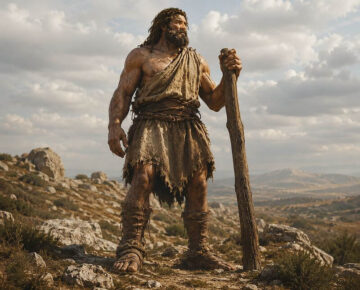
At first glance, the subject of giants may seem like a strange footnote in history, even an obscure detail from the ancient world, having no relevance to modern-day Christians. Many Christians avoid the subject or care little about it. Yet it is linked with one of the most troubling accusations raised against our Creator. The claim that he perpetrated the unthinkable.
On closer examination, the connection between giants and Israel’s return to the Land of Promise is significant. It sheds light on one of the greatest accusations leveled against our Creator—by both critics of the Bible and, at times, even by believers themselves. How could Elohim, the God of justice and light, do such a thing?
(In this article, ‘Yahweh’ refers to the personal, covenant name of God used in the Hebrew Bible, often highlighting his relational nature with His people. ‘Elohim’ refers to God as the Creator and mighty ruler, a more general term for God’s power and sovereignty.)
From a modern ethical lens, these events are challenging. Critics point to the commands of herem (the Hebrew word meaning devoted to destruction), where entire Canaanite nations were to be destroyed. Was this justice? Or, was this a world beyond recovery, where preserving the promised line of redemption was imperative? Could what seems like destruction on the surface, at its core, be an act of protection for all humanity? Let’s see how the narrative unfolds.
Our Old Testament writers did not treat this subject as trivia, nor did the ancient people of Israel. They understood it as part of a much larger truth — a thread woven from the earliest chapters of Genesis — a story that not only shaped the ancient world but, even today, speaks to the deepest questions of our own.
Why Giants Matter
I will repeat. One of the most troubling accusations raised against our Creator is the claim that the loving Father of the New Testament perpetrated genocide in the Old Testament. Passages such as Joshua 10:40 — where entire regions are described as being destroyed — have led many to conclude that such a God cannot be trusted nor followed. From a human perspective, these acts can feel unspeakable; they become a stumbling block that obscures even the message of Jesus himself. Why would we follow a tyrannical God like this?
However, the biblical record is often approached backward. Many readers assume they already understand the narrative, jumping directly to its most troubling moments without starting at the beginning. You don’t read any book that way, from the middle or the back of the book to the beginning.
To grasp the full picture, we must begin at the start and allow the story to unfold in order.
Cosmic Conflict.
The story of our existence in the Bible is not merely a human drama of nations rising and falling. It reveals a cosmic conflict between good and evil. A rebellion against Elohim with repeated attempts to distort what God created to be holy and to destroy the bloodline of salvation through which redemption would arrive for all of humanity.
Within that larger narrative, the conquest of Canaan is presented as indiscriminate violence. But we will see in our investigation that this return to the land promised to his people was bounded by covenant limits, acts of mercy, and a purpose far greater than one timeline of territorial war. We will trace the thread from Genesis through the rise of the giant clans. We will examine how divine boundaries were crossed, how corruption spread, and why the events in Canaan cannot be understood apart from that larger struggle.
Genesis 6 — An Assault on Humanity
Genesis 6 describes an event that most readers either skim over or assume is symbolic. But the ancient world did not read it that way—and the text itself presents it as an extraordinary transgression:
The sons of God saw the daughters of men that they were fair; and they took them wives of all which they chose. And the LORD said, My spirit shall not always strive with man, for that he also is flesh: yet his days shall be an hundred and twenty years.
There were giants in the earth in those days; and also after that, when the sons of God came in unto the daughters of men, and they bare children to them, the same became mighty men which were of old, men of renown. — Gen 6:2–5
The resulting offspring are described with chilling clarity:
And GOD saw that the wickedness of man was great in the earth, and that every imagination of the thoughts of his heart was only evil continually. Gen 6:5
The biblical claim is not simply that evil increased, or that violence spread (though it certainly did). It is that a boundary was crossed—something unnatural and forbidden occurred—producing a contamination that helped trigger the flood.
Most Bible-believing people believe that there were giants during the times of the Old Testament. David, Goliath and his brothers, others, but how they got there seems like a mystery in time, except that it isn’t. “Some readers already know where this is leading; others may not. But the implications become even more significant.”
This verse pinpoints the Giants’ origin. It’s clear and indisputable.
There were giants in the earth in those days… when the sons of God came in unto the daughters of men, and they bare children to them…” (Genesis 6:4)
This language goes beyond ordinary moral decline. It points toward corruption spreading in a way that threatens God’s created order. In other words, what happened in Genesis 6 was not merely sin—it was an incursion. This corruption reached into humanity itself. The goal of the enemy was to destroy humanity by infecting it with an entirely perverted and unnatural lineage, genos if you will. One that threatened the promised line through which redemption would come. One that never existed before and that would prevent the salvation of corrupted humanity.
Who Were the “Sons of God?”
A crucial clarification: the phrase “sons of God” in Genesis 6 does not mean New Testament believers (those redeemed in Christ). The Hebrew phrase is:
בְּנֵי־הָאֱלֹהִים (bene ha’elohim) — “sons of God.”
In the Old Testament, bene ha’elohim consistently refers to heavenly beings, members of Yahweh’s divine council or heavenly host—created spiritual beings who existed before Adam was created. The Book of Job uses the same phrase in a clearly supernatural setting:
“Now there was a day when the sons of God came to present themselves before the LORD…” (Job 1:6)
And again:
“…when the morning stars sang together, and all the sons of God shouted for joy.” (Job 38:7)
These are not humans. They are heavenly beings. Therefore, Genesis 6 does not describe “godly men marrying wicked women.” It describes rebellion in the heavenly order—created divine beings crossing a boundary that God established.
Why the Seth Line Interpretation Does Not Fit Genesis 6
Some biblical scholars have attempted to explain Genesis 6 as the intermarriage of Seth’s godly descendants with Cain’s ungodly line. While this interpretation is often presented as a safer or more symbolic reading, it does not align with the passage’s language. Genesis 6 never identifies Sethites or Cainites, nor does it describe covenant believers marrying pagans. Instead, the text uses the specific Hebrew phrase בְּנֵי הָאֱלֹהִים (bene ha’elohim, “sons of God”) — a term used elsewhere in Scripture to describe heavenly beings rather than human genealogies.
The passage also draws a deliberate contrast between the “sons of God” and the “daughters of men,” presenting them as distinct categories rather than as two human family lines. If both groups were simply descendants of Adam, the distinction would be unnecessary. Even more significant is the result of this union: the emergence of the Nephilim, described as mighty men of renown, uniting to bring a level of corruption so severe that God declared judgment upon the entire earth (Genesis 6:3–5).
The narrative portrays something far more diabolical than ordinary human intermarriage — it describes a rebellion that crossed the boundaries between heaven and earth, accelerated the violence that filled the world before the flood.
“And God made the beast of the earth after his kind, and cattle after their kind, and every thing that creepeth upon the earth after his kind: and God saw that it was good.” Gen 1:24
Epistle of Jude 1:6 (Key Greek Terms)
“…but they left their own habitation…”
- Greek word: οἰκητήριον (oikētērion)
- Meaning:
- dwelling place
- proper habitation
- appointed domain or form of existence
This isn’t just “a place they lived”—it implies a realm or state assigned to them by God.
“left their own habitation” (τὸ ἴδιον οἰκητήριον)
- ἴδιον = their own, proper, assigned
- οἰκητήριον = dwelling/habitation
They abandoned the domain or state that properly belonged to them. He has imprisoned them, reserved in everlasting chains under darkness unto the judgment of the great day.”
While Genesis 6 describes a spiritual boundary crossed by heavenly beings, modern science alters genetic boundaries—both involve tampering with what was originally ‘after its kind.’
In recent decades, scientific advancements have crossed natural boundaries. Genetic engineers now routinely combine genetic material from different creatures. For example, biotechnologists have inserted jellyfish genes into animals to make them glow, and human cells have been introduced into animal embryos for research. And I could go on and on.
The idea that boundaries cannot be crossed—whether spiritual or genetic—is mistaken. Understanding this correction matters for the larger story. Genesis 6 sets the stage for why the reality of giants and corruption reappears later in Scripture. The text is not describing the failure of Seth’s line; it’s unfolding the far-reaching, rebellious, usurping attempt to corrupt and destroy God’s creation.”
Most specifically, God’s human family. This abomination corrupted all the earth long before Israel entered Canaan.
Please note: In the Old Testament, humans are never referred to as “sons of God.” In the New Testament, “sons of God” specifically describes those who are born again.
Corrupting the Human Seed
There was a condition placed upon the first man and woman. It was simple and direct: “But of the tree of the knowledge of good and evil, thou shalt not eat of it: for in the day that thou eatest thereof thou shalt surely die.” Gen 2:17
Eve disobeyed, and Adam knowingly followed her into rebellion. But they did not die immediately, physically; however, they lost the spiritual life connection with their maker and no longer had eternal life.
From the earliest pages of Scripture, God promised a redeemer—one who would come from the seed of the woman and would crush the serpent (Genesis 3:15).
After humanity’s fall into sin, the human race was corrupted and unable to bridge the gap back to God on their own. The “seed of the woman” in Genesis 3:15 is understood as the promise of a redeemer—someone who would live their life untouched by the corruption of the fall.
If humanity’s very genos—its fundamental lineage or kind—became corrupted, then the promise of redemption would be in jeopardy. That was Satan’s aim. That is why Genesis 6 (‘the sons of God’ saw ‘the daughters of men,’ and they had children who became mighty men), is not a strange myth tucked into the margins of the Bible. It is a theological warning: the war was not only against human wickedness, but against powers attempting to corrupt the human race—violently, sexually, and spiritually—until the creation was no longer what Elohim intended it to be. What follows in the Bible—beginning with the flood, and later the conquest of Canaan—must be understood in that light.
We must ask: Is it possible that the presence of these tribes in Canaan was part of a strategic plan by Satan to corrupt or block God’s promise to Israel?
Based on the biblical texts and traditional interpretations, these tribes were not all viewed in the same way. Some were more directly connected to the ancient giant lineages described in Scripture. In contrast, others appear only indirectly associated with them.
The Old Testament presents varying degrees of connection between these peoples and the earlier giant traditions recorded in Genesis, Joshua, and Deuteronomy.
The Flood Was Not Only Judgment It Was Also Containment
To understand how these lineages reappeared, we must recall what happened after the flood. The incursion of Genesis 6 had lasting effects that extended far beyond the flood itself.” It accelerated a collapse already underway in the human heart, until wickedness became not merely widespread, but dominant—almost total.
“And GOD saw that the wickedness of man was great in the earth, and that every imagination of the thoughts of his heart was only evil continually.” (Genesis 6:5)
This verse is important because it tells us how far the corruption had spread. Human society was not merely “sinful” in a normal sense. It had reached a point where violence, rebellion, and spiritual defilement were no longer exceptions—they were the controlling atmosphere of life.
“The earth also was corrupt before God, and the earth was filled with violence.” (Genesis 6:11)
“And God looked upon the earth, and, behold, it was corrupt; for all flesh had corrupted his way upon the earth.” (Genesis 6:12)
Taken together, these verses show why the flood cannot be reduced to a simplistic “God was angry” explanation. The text presents the flood as both judgment and containment—a divine intervention that halted the spread of corruption threatening humanity’s future.
That is why Noah is described in distinctive terms:
“Noah was a just man and perfect in his generations… and Noah walked with God.” (Genesis 6:9)
The point is not that Noah was sinless, but that Noah stood as a preserved remnant—set apart in contrast to a world descending into total moral darkness and widespread corruption. In Noah, Yahweh preserved a line through which his purposes for mankind—and ultimately the coming Redeemer—would continue.
But Genesis does not end the story there. The flood removed the corrupted world, yet later biblical history shows that the giant problem reappears—most notably in Canaan. And this leads directly to the moral controversy that troubles so many readers: the conquest.
How were “Giants” Born to Women?
First: Genesis 6 presents the mothers simply as the “daughters of men, normal human women. The abnormality was not the women themselves, but the nature of the union and the resulting offspring (the Nephilim, the “mighty men of renown”).
Second: Human childbirth already demonstrates that women can bear children who grow far larger than themselves. Genesis 6 does not provide a mythical explanation of childbirth, but a biblical explanation for the unlawful union and the corrupting offspring that resulted from it.
If the ‘Sons of God’ were heavenly beings, how does Scripture portray their ability to act in the physical world?
A) The text presents the union as a real event.
Genesis 6 does not describe the union as a metaphor, parable, or vision. It presents it as an actual transgression: the “sons of God” took wives and produced offspring (Genesis 6:1–4). Whatever interpretation one ultimately adopts regarding the identity of these beings, the text itself portrays a real violation with real consequences.
B) Scripture portrays heavenly beings as capable of physical manifestation.
Elsewhere, the phrase “sons of God” refers to heavenly beings (Job 1:6; 2:1; 38:7). Scripture also contains multiple accounts of heavenly messengers appearing in tangible, embodied form (e.g., Genesis 18–19, where the visitors are perceived physically and interact with the material world).
Again, the Bible does not provide a biological explanation for these events, nor is that its purpose. It does, however, present spiritual beings as capable of operating within the physical realm. Scripture does not explain the mechanics; it emphasizes the reality of the transgression and its outcome.
According to Their Own Kind
And God said, Let the earth bring forth the living creature after his kind, cattle, and creeping thing, and beast of the earth after his kind: and it was so.” — Genesis 1:24 (KJV)
Doesn’t (After their own kind) prove angels could not reproduce with humans? The “after their own kind” principle describes creation as God originally ordered it. Genesis 6 describes a rebellion against that order—an attempt to corrupt creation itself. You do not refute a transgression by appealing to the law it violated; rather, the horror of the act is revealed precisely because it broke the rule.
A Clarification: “According to their kinds” is language from Genesis 1 about God creating living creatures, plants, animals, etc., and their capacity to reproduce within created categories. The Hebrew word most often discussed is mîn (“kind”), and scholars debate how closely it corresponds to modern taxonomy.
Genesis 1 describes God’s good design for ordinary creation. Creatures reproduce within their created boundaries.
Genesis 6 describes an extraordinary rebellion: a boundary violation. The question is not whether God’s design permitted this, but whether rebellious beings could transgress that design. Genesis 6’s whole point is that they did—and the result is portrayed as corrupting and catastrophic.
Even within ordinary creation, humans have learned that boundaries in nature are more complex than we once assumed. Closely related species can produce hybrids, and modern science can even transfer genetic material across biological lines. While Genesis 6 describes something far more profound than human experimentation, it reminds us that the biblical concern is not that boundaries were impossible to cross — but that they were never meant to be crossed.
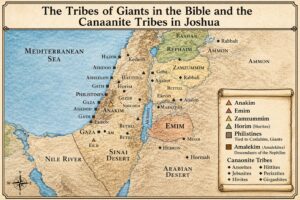
The Giants Return: Why Canaan Became the Battleground— A Quick Reference
What binds these people together in the biblical narrative is not merely unusual stature, but a deeper corruption that traces back to boundaries crossed long before Israel entered the promised land. Genesis describes a rebellion that produced offspring outside the created order, and later traditions connect certain giant clans with that legacy — peoples who were no longer fully human in the pure sense intended at creation. Their societies became marked by violence, entrenched idolatry, and practices that Scripture presents as horrifically destructive, including the burning of children as offerings in sacrificial fire.
For this reason, the conquest narratives do not depict Israel engaging in indiscriminate war against every nation. Instead, they focus on specific cultures whose corruption had reached a point of judgment. Understanding where these tribes lived and how they were connected to the wider history of rebellion clarifies that the conflict in Canaan was not random ethnic destruction, but a targeted confrontation with systems that threatened to erase the knowledge of the true God from the land.
At the same time, Scripture sets clear limits: Edom, descended from Esau and Moab and Ammon, descended from Lot, were protected from Israelite aggression. These boundaries reveal that the conquest was selective, covenant-driven, and morally framed — not an indiscriminate campaign of genocide.
A Short Definition Of The Tribes
Nephilim
Hebrew: נְפִלִים (Nephilim) — “fallen ones”
Greek (LXX): γίγαντες (gigantes, “giants”)
Mentioned before the Flood (Genesis 6:1–4), the Nephilim are associated with a period of extreme corruption and violence. Later traditions connect post-flood giant clans to their legacy.
Rephaim
Hebrew: רְפָאִים (Rephaʾim)
Greek: γίγαντες (gigantes)
A broad biblical term for ancient giant peoples living east of the Jordan, especially in Bashan. King Og is described as one of the last of the Rephaim (Deuteronomy 3:11).
Anakim (Children of Anak)
Hebrew: עֲנָקִים (ʿAnaqim)
Greek: γίγαντες (gigantes)
Descendants of Anak living in the hill country of Canaan, particularly around Hebron. Their stature terrified Israel’s spies (Numbers 13:28–33; Joshua 11:21–22).
Emim
Hebrew: אֵמִים (ʾEmim) — “terrible ones.”
Greek: γίγαντες (gigantes)
A powerful giant people who once inhabited Moab before being displaced (Deuteronomy 2:10–11). The Moabites were descended from Moab, the son of Lot, Abraham’s nephew.
Zamzummim (Zuzim)
Hebrew: זַמְזֻמִּים (Zamzummim); זוזים (Zuzim)
Greek: γίγαντες (gigantes)
A large and numerous people living in the land later called Ammon (Deuteronomy 2:20–21; Genesis 14:5).
Horim (Horites)
Hebrew: חֹרִים (Ḥorim) — “cave dwellers”
Associated with Mount Seir. Though not always explicitly called giants, they appear in the same ancient pre-Israelite landscape (Deuteronomy 2:12, 22). (Esau, the twin brother of Jacob (Israel), became the Father of the Edomites.)
Philistines
Hebrew: פְּלִשְׁתִּים (Pelištîm)
Known from the coastal plain cities such as Gaza and Gath. Later narratives connect them with giant warriors like Goliath (1 Samuel 17; 2 Samuel 21).
Amalekites
Hebrew: עֲמָלֵק (ʿAmaleq)
Nomadic enemies of Israel in the southern wilderness. Some traditions associate them with ancient giant lineages (Genesis 14:7; Exodus 17).
Geshurim & Maachathim
Hebrew: גְּשׁוּרִי (Gešuri), מַעֲכָתִי (Maʿăkāti)
Northern peoples near Bashan whose territories overlapped regions once associated with the Rephaim (Deuteronomy 3:13; Joshua 13:11, 13).
What Joshua Did — and Did Not — Destroy
Joshua’s campaigns did not remove every tribe from the land. Scripture notes that the Philistine cities along the coast remained unconquered, the Geshurites and Maacathites continued living in the north, and the Jebusites held Jerusalem until the time of David (Joshua 13:13; 15:63).
Several Canaanite strongholds, such as Beth-shean and Megiddo, were not destroyed but were later subjected to forced labor (Joshua 17:12–13). Even remnants of the Anakim survived in Gaza, Gath, and Ashdod (Joshua 11:22).
Yet not all survivors remained enemies. The Gibeonites entered into a covenant with Israel. They were spared (Joshua 9), and individuals like Rahab of Jericho were welcomed because of their faith (Joshua 2; 6:25).
These examples reveal that the conquest was neither absolute nor indiscriminate; it unfolded within clear covenant boundaries, showing that judgment was directed toward entrenched corruption rather than toward ethnicity itself—a distinction that becomes essential for understanding why the presence of the giants matters within the larger biblical narrative.
The Land was Promised to Abraham
Long before Joshua crossed the Jordan, the land of Canaan had already been promised by the Creator to Abraham and his descendants. God declared that Abraham’s offspring would inherit the land stretching from the river of Egypt to the great Euphrates (Genesis 12:7; 15:18–21). Yet even then, the promise came with a delay. The Lord told Abraham that the judgment would not come immediately, “for the iniquity of the Amorites is not yet complete” (Genesis 15:16). This reveals that the conquest of Canaan was never impulsive or arbitrary; it unfolded after centuries of moral decline and spiritual corruption.
By the time of Joshua, the land was occupied by powerful nations entrenched in idolatry and violence. Many of these peoples were connected to the ancient giant clans that had spread throughout the region. Israel’s arrival, therefore, was not merely an invasion but the fulfillment of a covenant promise combined with divine judgment against systems that had long resisted God’s purposes.
Yet Scripture also draws clear boundaries. Israel was not permitted to destroy every neighboring people. God specifically forbade attacks against certain nations because their lands had been allotted to other descendants of Abraham’s extended family. The Israelites were commanded not to provoke Edom, the descendants of Esau; not to attack Moab, the children of Lot; and not to contend with Ammon, whose territory God had likewise granted (Deuteronomy 2:4–5, 9, 19). These instructions demonstrate that the conquest was targeted rather than indiscriminate.
Even within Canaan itself, mercy appeared alongside judgment. One of the clearest examples is Rahab of Jericho, a woman who turned from the city’s ways and aligned herself with the God of Israel. Because of her faith and protection of the spies, she and her household were spared when the city fell (Joshua 2; 6:22–25). Rahab’s story shows that the issue was never ethnicity alone; allegiance and repentance mattered. Anyone who turned toward the Lord could find refuge, even in the midst of conflict.
Taken together, the promise to Abraham, the restrained commands given to Israel, and the mercy extended to Rahab reveal a deeper pattern within the conquest narrative. The biblical story does not portray random destruction but rather a measured fulfillment of covenant promises, combined with opportunities for repentance.
Understanding this framework helps explain why the presence of the giant clans matters — they were part of a larger spiritual landscape in which the Creator was both judging corruption and preserving a path toward redemption.
Giants and Israel before the conquest
Another detail modern readers often miss is that Israel encountered real, demonstrated hostility long before Joshua crossed the Jordan. Certain groups refused Israel peaceful passage and came out to fight—most notably Sihon, King of Heshbon, who denied transit and was defeated (Numbers 21:21–31).
Others attacked the vulnerable from behind. Amalek, for example, struck Israel soon after the Exodus and is remembered for targeting the weak and stragglers (Exodus 17:8–16; Deuteronomy 25:17).
This matters because the conflict was not imaginary or provoked by Israel’s ambition; hostility was shown, and Yahweh’s judgments were not issued in a vacuum.
Amalek is the clearest example of selective judgment. They were the one people God declared would be “blotted out from under heaven” because of relentless violence against the weak of Israel and continued rebellion against his covenant purposes — showing that even the most severe commands in Scripture were aimed at entrenched corruption, not at humanity indiscriminately.
Yet Scripture also shows a moral distinction: not every group responded the same way. Some tribes pursued hostility. Others requested terms, sought a covenant, or attempted a truce. Mercy existed—but not for hardened, hostile strongholds committed to violent resistance.
Let’s Catch Up — Take a Breath
- Genesis 3 — The First Rebellion
Humanity falls as a created adversary turns against the Creator. Yet even in judgment, a promise emerges: a coming Seed who will crush the serpent and restore what was lost. - Genesis 6 — Boundaries Broken
The “sons of God” cross a forbidden line, intermingling heaven and earth. Violence fills the world, and the flood comes as a reset — not to erase God’s plan, but to preserve it. - Genesis 11 — Babel and the Scattering
Humanity gathers in defiance, building unity apart from God. Languages are confused, nations are scattered, and the earth is divided according to God’s design. - Genesis 12 — The Call of Abraham
From the scattered nations, God calls Abraham — an elderly man with a barren wife — to begin a covenant line sustained not by human strength, but by divine promise. The promise of reunion with God is beginning. - The Bigger Picture
The rise of Canaanite nations and the appearance of the giants unfold within the ongoing conflict between rebellion and redemption. Before asking whether God caused genocide in Canaan, we must first see the pattern: when divine boundaries are crossed and corruption spreads, God intervenes to preserve His promise and protect the path of the coming Seed.
Why Some Clans Had to Be Removed From Existence
At this point, many readers feel the weight of the hardest question: Why did Yahweh command the removal of entire clans and strongholds in Canaan?
The modern mind often assumes there are only two categories: innocent civilians versus violent soldiers. But the Old Testament presents the situation as something far deeper. Canaan had become a convergence point of entrenched wickedness, violent hostility, and—in certain lines—the continuation of an ancient corruption tied to the giant traditions.
First, we must be clear: the conquest was not a race war.
Scripture explicitly distinguishes between peoples. As we said, Israel was forbidden to attack certain nations (Edom, Moab, Ammon). This alone dismantles the claim that Yahweh was commanding indiscriminate ethnic violence. Israel did not have blanket permission to kill whoever it wished. They were constrained.
Even within the land, specific groups are named, and the command is focused: seven nations are marked for judgment in Canaan (Deuteronomy 7:1–2), and the Anakim giants are singled out as well.
The Old Testament uses a severe word for certain Canaanite strongholds: ḥērem—something placed under the ban, “devoted” to destruction. That language matters because it indicates this wasn’t merely punishment for minor moral failures. It was judgment against a kind of evil that had become entrenched.
A second purpose runs alongside judgment: protection. Israel was carrying the covenant promise. Through Israel would come the Seed—the Redeemer—by whom salvation would come into the world. If Israel absorbed Canaan’s gods, practices, and corrupted alliances, the covenant line would be poisoned.
The conquest narrative includes mercy—but it is mercy offered under covenant terms (Rahab; the Gibeonites). Mercy was possible. But mercy was not granted to entrenched, hostile strongholds determined to remain corrupt and violent.
The removal of certain clans was not Yahweh committing evil—it was Yahweh restraining evil. Some of these strongholds were so corrupt, so violent, and in certain cases so tied to the continuation of the ancient contamination that Scripture regards them as a threat not just to Israel, but to the future of mankind as Yahweh intended it.
From Joshua to David: The Long War Ends
Joshua’s conquest was decisive, but it was not instantaneous in its outcomes. The Bible itself makes this point clear: some strongholds remained, and the consequences were felt for generations.
Scripture records that Joshua cut off the Anakim, yet notes a crucial exception:
“…only in Gaza, in Gath, and in Ashdod did some remain.” (Joshua 11:22)
Those remnants later appear in Philistine territory and trouble Israel again, producing figures such as Goliath and other giants of Gath.
The Philistines were not fully removed under Joshua; five major cities remained (Gaza, Ashdod, Ashkelon, Gath, Ekron). Jerusalem itself remained a Jebusite stronghold until David captured it.
When David faces Goliath, Scripture is showing more than courage. David is striking down a remnant. The later texts that record the deaths of other giants confirm the theme: what Joshua began, David completed. The remnants of the giant line were finally cut off, and the land was secured.
The Greater Point: Redemption Through Christ
If we stop at Joshua, or even at David, we may conclude that the Bible is simply a story about judgment. But Scripture never intended the conquest narratives to stand alone. They are part of a single unfolding story—a story moving steadily toward redemption.
The moral and spiritual tragedy that begins in Genesis does not end with the removal of giant clans. Mankind’s greatest enemy is the sin that entered the human heart and spread to all humanity.
That is why the Old Testament leads directly to Christ.
Christ Jesus came as the true and faithful son—fully human, without corruption, without sin. He lived the perfect life Yahweh intended for all mankind before the fall, before the Watchers’ transgression, and before the scattering at Babel. And then he did what no conquest and no king could ever do: He dealt with sin at its root.
Through Christ Jesus, mankind has been provided a means of reconciliation with God. All mankind has been provided a means of reunion with God through his son, who lived the perfect life that God had intended for all his people. Through his cross and resurrection, Yahweh’s goal is not merely the removal of evil tribes but the redemption of fallen people. The Bible’s final word is not eradication. The Bible’s final word is restoration. Clearly, God did not intend total destruction for its own sake, but rather that, through this judgment, he would preserve a line of redemption for all mankind.
The same God who judged corruption also provided the only remedy for corruption: salvation through Jesus Christ.
And that is why Giants Matter.
The final point I’d like to make is this: many now presume to judge what God Himself calls light or darkness, as though the creation may once again sit in judgment over the Creator. I hope this article has clarified what I believe is a key missing point in the question: Why Giants Matter. Giants, Canaan, and Judgment: Did God Command the Unthinkable?
Anthony Barbera_May-15-26
ADDENDUM: Common Questions and Objections
Objection 1: “This was genocide.”
Scripture does not treat the conquest as an ethnic purge. It is a targeted judgment against defined strongholds and specific peoples—while other nations are explicitly off-limits (Edom, Moab, Ammon).
Objection 2: “God commanded Israel to kill innocent people.”
The Bible presents these societies as entrenched strongholds of corruption, violence, and spiritual bondage—not innocent villages. The narrative includes mercy exceptions (Rahab; the Gibeonites), showing the conquest was not indiscriminate bloodlust.
Objection 3: “The ‘giants’ stuff is myth.”
The Old Testament repeatedly names tribes and lineages (Rephaim, Anakim, Emim, Zamzummim/Zuzim, Horim) and identifiable remnants (Og, Goliath). This is not mythic vagueness; it is narrative specificity.
Objection 4: “This is just Israel justifying land theft.”
Israel is forbidden to attack some nations, is judged when disobedient, and does not win automatically. The Bible portrays covenant judgment, not human ambition. Incomplete conquest became a snare (Judges 2:2–3).
Objection 5: “If God is loving, He would never judge like this.”
Love and justice are not opposites. The conquest texts show Yahweh judging entrenched evil while preserving a path toward salvation for all nations through the promise line—ultimately fulfilled in Christ.
Objection 6: “Why not punish only leaders?”
The Bible portrays integrated cultural and spiritual strongholds, not isolated ‘bad leaders.’ Hostility was demonstrated, not hypothetical (e.g., Amalek).
Objection 7: “Israel spared some people, so it was negotiable.”
Yes—mercy was real. Rahab and the Gibeonites were spared under the covenant. These exceptions show Yahweh was not commanding blind violence, while also showing mercy came through submission to Yahweh.
Objection 8: “If conquest was necessary, why wasn’t it completed?”
Because Israel disobeyed—and the consequences proved that Yahweh’s warning was foresight: idolatry, continual warfare, and giant remnants that later troubled Israel (e.g., Goliath).
Notes (Scripture References)
- Genesis 6:2, 4, 5, 9, 11–12; Genesis 3:15; Job 1:6; Job 38:7.
- Numbers 13:33; Deuteronomy 2; Deuteronomy 7:1–2; Joshua 11:21–22; Joshua 13; Joshua 15:63; Judges 2:2–3.
- 1 Samuel 17; 2 Samuel 21:15–22; 1 Chronicles 20:5; Deuteronomy 3:11; Joshua 12:4; 2 Samuel 5:6–7.

One Comment
Beautifully described. Beautifully written!!! NOTE: With the Amalekites, Saul was supposed to destroy them. He didn’t. Then David went after them, but some 400 got away. It wasn’t until the sons of Solomon that ALL the Amalekites were finally destroyed – no progeny at all!!! So, I may have missed something, but originally, the demons that crossed the line and disobeyed were sent to prison in hell. My observation: there are still demons that try to cross the line and go against the Name of Jesus Christ, which they CANNOT do, or they try to cross over the power of the blood of Jesus that we can put in place. No demon should be able to cross that line, and yet they do try. So, can we not ask the Lord to have his angels “escort” those disobedient demons to join the others in the prison in Hell, where the other disobedient ones were originally assigned? Also, do you think that the giant (hybrid) bloodline came through in one or more of the sons of Noah or the wives?-Something to think about, yes? God has always been good and just, and of course, He was doing all the things you wrote about FOR US!! His works have always been for the blessing of His people!!! thanks for this write-up. It’s so well studied and really great! Love you, Caroyn