How Pentecost reversed the Tower of Babel
Anthony J. Barbera
February 27, 2026
Many readers notice something remarkable when they compare Genesis 10–11 with Acts 2. The final day of the Feast of Weeks — Shavuot — had come. It was the fiftieth day since Passover. The apostles were gathered together in one place, watchful and waiting for what the Lord had promised.
To the Judeans who had traveled for weeks — sometimes months — from among the nations, Shavuot marked the culmination of seven full weeks after Passover. To the Greek-speaking world, the day was called Pentecost, meaning simply “the fiftieth.”
When the Holy Spirit descended on that day, the festival was not replaced — it was fulfilled and given deeper meaning.
“And it shall come to pass afterward,
that I will pour out my Spirit upon all flesh;
and your sons and your daughters shall prophesy…”— Joel 2:28
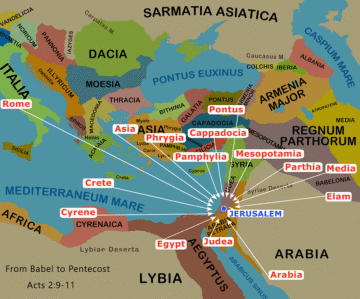
From the same nations once scattered at Babel, representatives were now present in Jerusalem. Pentecost was not merely a miracle of languages — it marked the beginning of God’s visible restoration and outreach, through His Son Jesus Christ, to “every nation under heaven.”
The Nations at Babel — The Masoretic Text
The list of 70 nations comes from the Masoretic Text of Genesis 10, often called the Table of Nations. These seventy ancestral peoples represent the biblical picture of the known world — stretching from the western seas toward Tarshish (Spain), across North Africa, and into Mesopotamia and Arabia.
At Babel (Genesis 11), humanity united in pride and rebellion. God confused their language and scattered them across the earth. The scattering fulfilled God’s command to fill the earth — yet it also symbolized separation: people divided from one another and estranged from God. Centuries later, further dispersions occurred. The Assyrians carried away the northern kingdom. The Babylonians overtook Judah. The people of Israel themselves experienced scattering among the nations.
The Risen King and the Promise of the Spirit
Acts opens with the risen Jesus Christ spending forty days instructing His disciples about the kingdom of God. This continues Luke’s message: God’s reign is being restored — beginning in Israel and extending to the nations.
Jesus promised that the Holy Spirit would come and empower His followers. This fulfilled the prophetic hope that God would dwell among His people in a new way, transforming hearts and forming a living temple.
He commissioned them to be His witnesses:
- In Jerusalem
- In Judea
- In Samaria
- And to the uttermost parts of the earth
But first — they were to wait.
“Wait in Jerusalem” — The Promise of the Father
Before His ascension, Jesus instructed the disciples to remain in Jerusalem until they received “the promise of the Father.” They were not told the exact hour or day.
Then came that appointed moment. When Pentecost arrived, the Spirit descended with power. Tongues like fire appeared. The disciples spoke as the Spirit gave utterance. Pilgrims from the diaspora heard the message in their own languages. Pentecost did not erase earthly tongues — it filled them with the message of Christ, proclaiming the mighty works of God. At Babel, people sought to exalt themselves.
At Pentecost, God acted — exalting His Son and sending His Spirit so that the message of Jesus Christ would be proclaimed clearly to the nations.
Babel and Pentecost — A Beautiful Symmetry
See a striking pattern?
- At Babel: One language led to confusion and scattering.
- At Pentecost: Many languages were understood, bringing unity.
- At Babel: Humanity tried to make a name for itself.
- At Pentecost: God’s mighty works were proclaimed.
- At Babel: People were scattered across the earth.
At Pentecost, Pilgrims gathered in Jerusalem and then carried the gospel back to the nations.
Each man heard the message in his own language. This was not confusion—it was intentional. But why would God choose language as the sign?
To understand the new language revealed at Pentecost, see Unveiling the Truth About Speaking in Tongues.
Why All Seventy Nations Do Not Appear on the Map
- The Pentecost map represents the gathering of nations, but it does not list each of the seventy individually.
- This is understandable:
- Genesis names ancestral lineages, not later political countries. Many clans later blended into larger regions.
- Acts lists major regions, not every genealogical branch. A region like Egypt or Asia could include multiple Genesis peoples.
- A map reflects geography, not genealogy.
- Thus, the first-century geography of Acts points back to the theological structure of Genesis 10 without reproducing every ancestral name.
From Dispersion to Restoration
- The Day of Pentecost marks the beginning of Babel’s reversal.
- God gathers people “from every nation under heaven.” He pours out His Spirit. He sends the message of Jesus Christ outward into the world.
- Babel scattered in judgment. Pentecost gathers in grace.
- The nations once divided by language now hear one message — the promise of redemption through Christ.
- What began in Jerusalem would move outward, fulfilling the commission to carry the gospel to the ends of the earth.
As you view the accompanying map, remember: it represents the visible gathering of many dispersed peoples. Not every ancestral name from Genesis appears individually — yet the meaning remains unmistakable.
The nations once scattered are beginning to hear one voice again through the Spirit of God.
Gratitude,
Anthony Barbera
2-27-26



3 Comments
Great comparison. Thanks!!
Well said; thank you!
Great incite Anthony